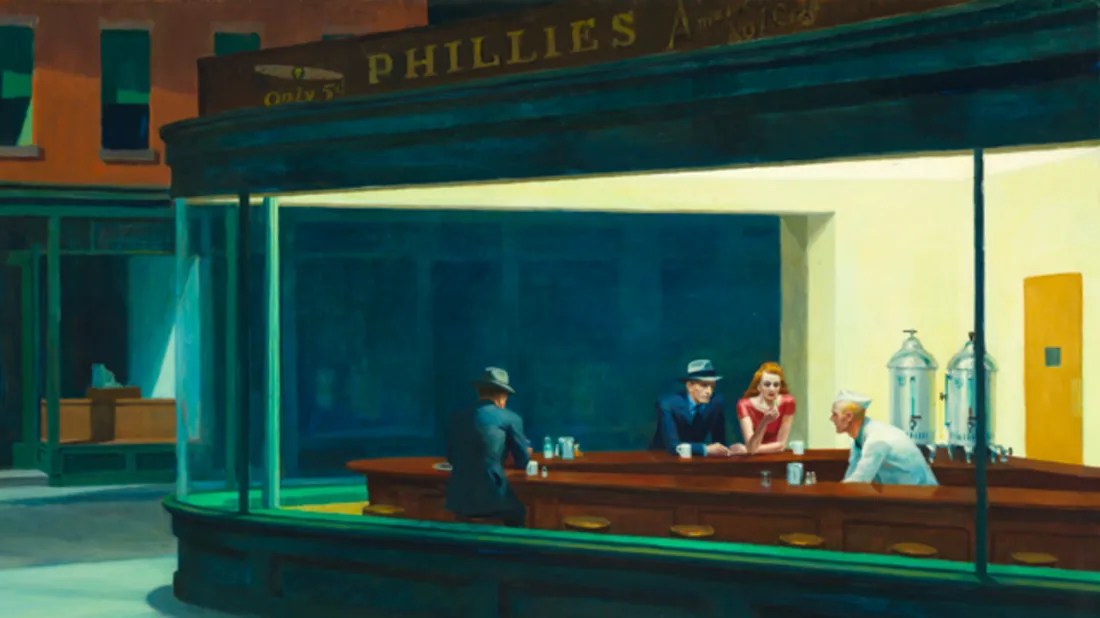
Nighthawks*, de Edward Hopper
Vê como ela está sentada perto do homem
de terno azul? Vê como as mãos deles
quase se tocam? Como ela me lembra
minha mãe — uma mulher de vermelho
tomando café. Vê?
Hopper obviamente se sentia só.
Por que outro motivo pintaria ela, minha mãe,
sentada ali assim?
E isso me faria o quê?
O balconista de branco?
Disposição não me falta. Quero ajudar.
Mesmo que isso signifique apenas esperar
para acender o cigarro de cada homem.
Minha mãe passava as
noites sozinha, limpando a poeira
das canecas de café. Como as linhas
que em sua boca se aprofundavam…
Vê? E se ela morresse
assim — triste, intocada?
Eu digo, quero ajudar,
mas é como se minha voz fosse uma torneira
aberta, o zumbido vazio de uma geladeira.
Hopper obviamente se sentia só.
Por que outro motivo pintaria o homem de terno cinza
no balcão, meu pai, de costas?
Trad.: Nelson Santander
*N. do T.: “Nighthawks” (1942), de Edward Hopper, retrata três clientes e um atendente numa lanchonete noturna. A obra pertence ao Art Institute of Chicago. O título pode evocar os “notívagos”, pessoas que permanecem ativas até tarde. No poema, o eu lírico reconhece nas figuras pintadas uma cena de sua própria história familiar.
Nighthawks by Edward Hopper
See how closely she sits to the man
in the blue suit? See how their hands
almost touch? How she reminds me
of my mother — a woman in red
drinking coffee. See?
Hopper was obviously lonely.
Why else would he paint her, my mother,
sitting there like this?
Which would make me what?
The soda jerk in white?
I’m eager enough. I want to help.
Even if it means simply waiting
to light each man’s cigarette.
My mother spent
nights alone, wiping coffee mugs
clean of dust. How the lines
that her mouth deepened…
See? And what if she died
this way — sad, untouched?
I say, I want to help
but it’s as if my voice is a faucet
running, a refrigerator’s empty hum.
Hopper was obviously lonely.
Why else paint the gray-suited man
at the counter, my father, his back turned?
Deixe um comentário