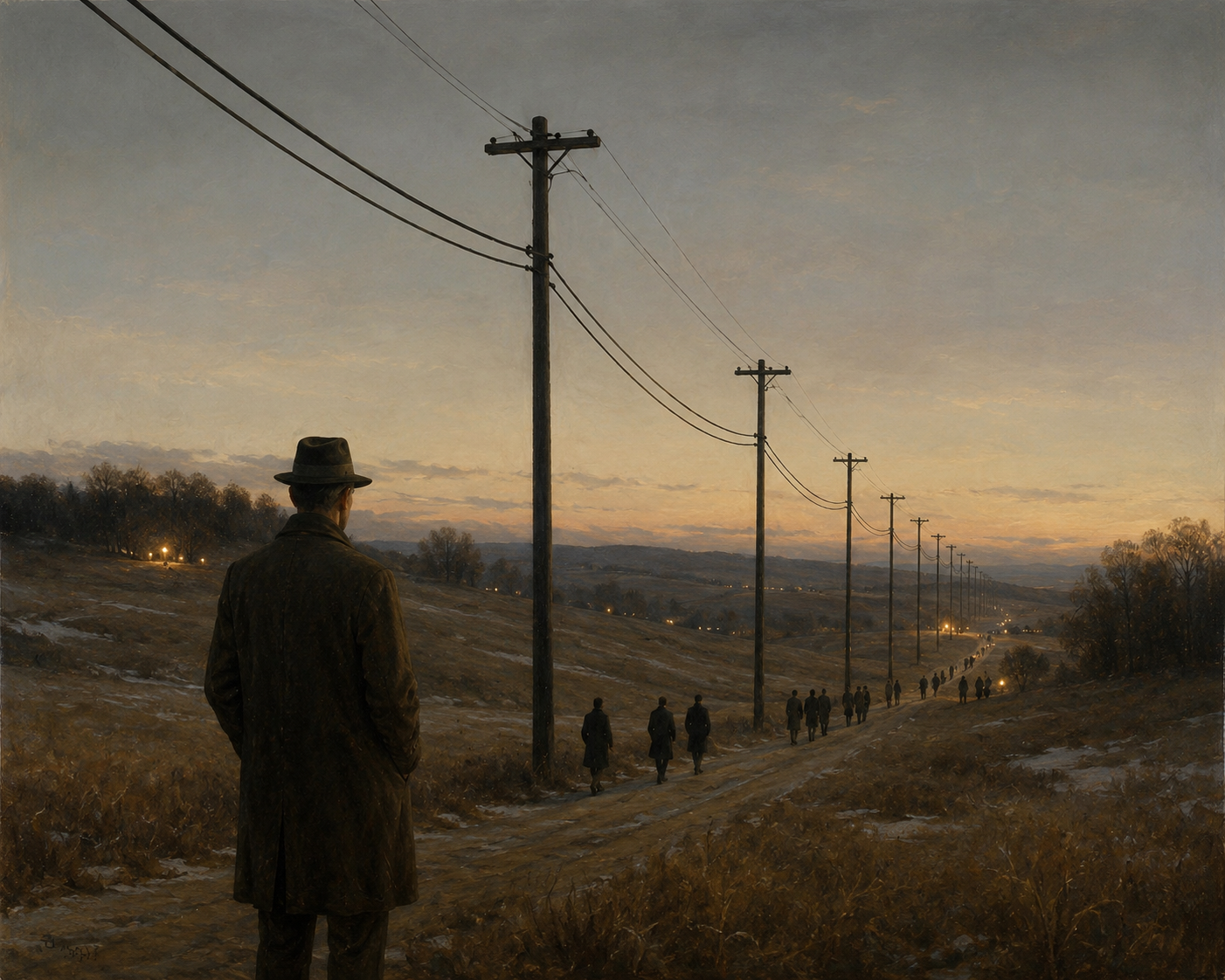
O que meu pai tinha a oferecer?
Percebi, ainda menino,
que ele não sabia construir nem consertar nada,
e mais tarde me ocorreu
que tampouco tinha ideias originais.
Ele sabia contar piadas que faziam rir as pessoas,
cuidar das contas, sobretudo as alheias,
e participar de comissões.
Nada que interessasse muito a um menino.
E havia outra coisa: ele ia a funerais.
Muitas vezes, à noite, depois do trajeto
de ida e volta à cidade,
ele saía outra vez, sem grande entusiasmo,
para a confraria ou algum comitê da igreja,
e não raro era a um funeral que comparecia.
Era uma decência que ele tinha. Eu talvez soubesse
disso. Mas jamais teria imaginado
que ele cultivasse qualquer mistério.
Só recentemente aprendi que,
quando você se senta na primeira fila,
no clima eterno da funerária,
é surpreendente, e reconfortante,
ver os rostos que surgem diante de você
e passam, não muito distante de onde ele repousa.
É um mistério. Talvez
a própria decência seja um mistério,
ou talvez só cruzemos de uma para o outro
por uma ponte de pesar.
O pai do meu pai morreu
quando meu pai tinha vinte e três anos.
Meu pai era um homem que sustentava os cabos.
E eu comecei a ir a funerais.
Trad.: Nelson Santander
My Father Went to Funerals
What could my father do?
I realized when I was still small
that he couldn’t build of fix anything,
and later it occurred to me
that he had no original thoughts.
He could tell jokes that made people laugh,
keep track of money, mainly other people’s,
and serve on committees.
Not what a boy could care much about.
And another thing: he went to funerals.
Often in the evening, after the commute
into the city and back from the city,
he went out again, mildly against his will,
to the lodge or some church committee,
and often enough it was a funeral he attended.
It was a decency he had. I knew that,
maybe. But I would not have thought
he tended any mystery.
I have learned, only lately,
that when you sit in the front row
in the eternal weather of the funeral parlor,
it is surprising, and a relief,
to see the faces that appear before you
and pass by, not far from where he lies.
It is a mystery. Maybe
the decency itself is a mystery,
or maybe we cross from the one to the other
only on a bridge of grief.
My father’s father died
when my father was twenty-three.
My father was a man who held the cables.
And I have begun to go to funerals.
Deixe um comentário